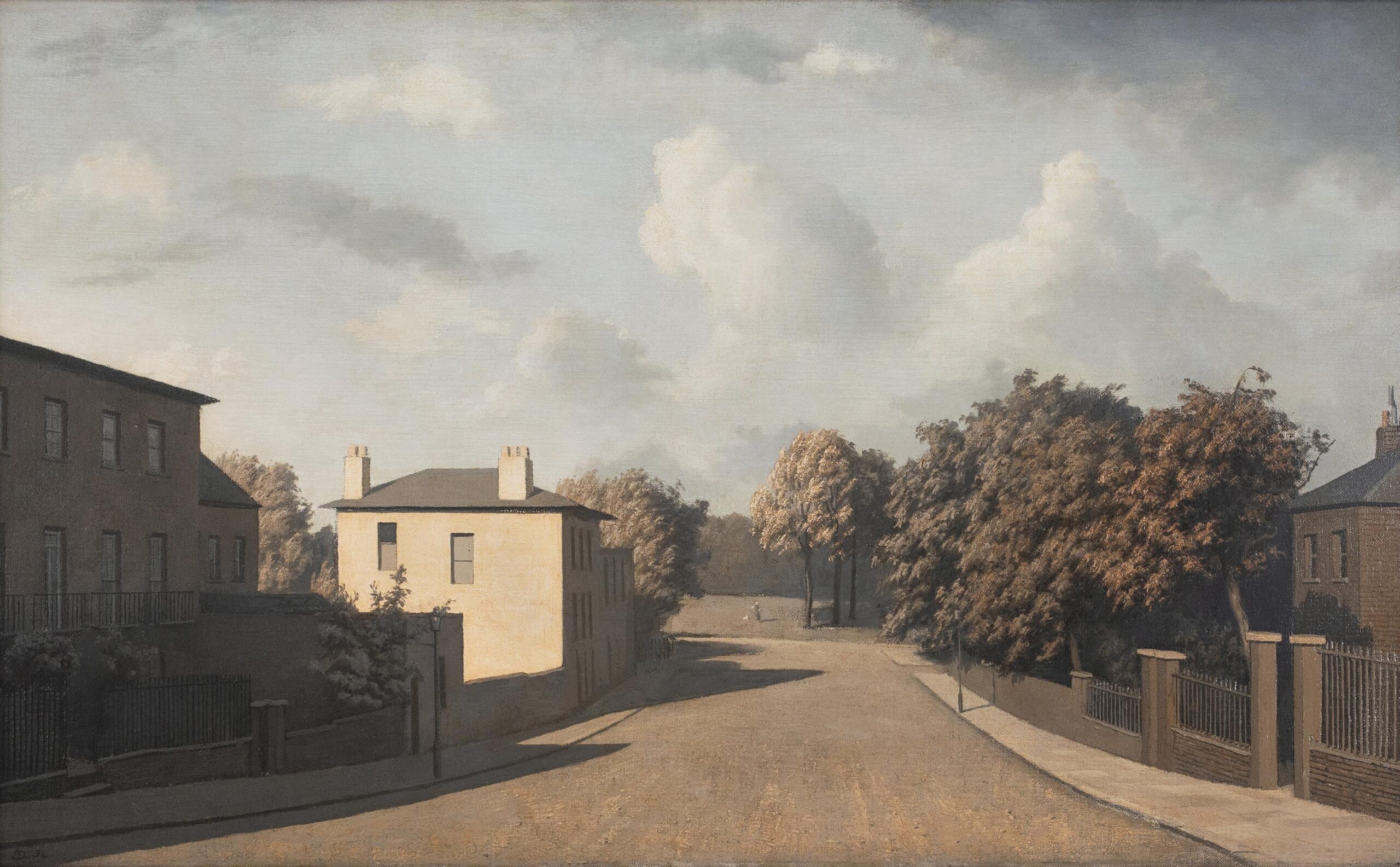
Algernon Newton was born in Hampstead in 1880, a grandson of Henry Newton, one of the founders of Winsor & Newton, the renowned art materials company. His 1934 painting ‘Downshire Hill’, Hampstead captures a moment in the early 20th century when many of the buildings on this charming street were little more than a century old.
What the Painting Shows
The work depicts the north-eastern end of Downshire Hill as it runs down to Hampstead Heath, featuring the former Freemasons Arms and the entrance to the heath beyond. Newton’s composition is characteristically foreshortened, bringing the edge of the heath closer to the viewer than it appears in reality. This artistic choice allows him to express a more expansive scene—a typical Newton approach where atmosphere and architecture take precedence over human activity.
A Personal Connection to Downshire Hill
Newton’s choice of this particular view was no coincidence. His daughter, Pauline Mary, married Basil Murray, whose brother Stephen lived at 25 Downshire Hill. The vantage point of the painting is located almost exactly on the street outside number 25.
As the painting is dated 1934, it seems likely that Newton chose this view knowing it would soon be lost forever. The old Freemasons Arms was demolished in 1935, just a year after Newton completed this work.
The History of the Freemasons Arms
The original Freemasons Arms was built in 1819 and positioned on the road’s edge, slightly further toward the heath. It was a lively conglomeration of two disparate buildings, unified through Neo-Classical embellishment.
The new Freemasons Arms, completed in 1936, was built abutting number 31 Downshire Hill. In Newton’s painting, this smaller, lower building is the last house in the row on the left, occupying the space shown as a low wall in the artwork.
Notable Buildings in the Scene
Numbers 29 and 30 Downshire Hill
These properties appear on the left of the painting, complete with their metal railings at first-floor level—railings that remain in place today.
Number 35 Downshire Hill
Visible on the right-hand side of the painting, this was the former home of Margaret Gardiner, described as a radical modern British patron of artists. Her garden once housed “Curved Form (Trevalgan)”, a 1956 bronze sculpture by Barbara Hepworth, now in the Pier Art Centre in Stromness, Orkney Islands.
Number 36 Downshire Hill
This property disappears into the shadows of the trees at the edge of the composition.
107 South End Road
Interestingly, Newton chose not to include this building, which occupies a dominant position at the end of the street. Period photographs from the early 1950s show the houses along South End Road clearly visible from this vantage point. Newton faithfully reproduced the row of trees that would have hidden the property from view. Number 107 was extensively remodelled in the late 1950s.
Reading the Light and Season
Judging by the light and shadows, Newton has depicted the street in late afternoon—the houses on the north-eastern edge fall into shadow at around 3pm. The trees in full leaf suggest early summer.
This timing would place the Freemasons Arms in its final days. Newton has even painted the windows in a way that suggests they may be boarded up.
The Atmosphere of Change
Downshire Hill, at the junction of Willow Road and South End Road, can be windy, with breezes coming down off the heath toward South End. Newton captures this perfectly in his depiction of the willow trees behind the Freemasons Arms—trees that gave Willow Road its name but have sadly now gone.
This is a wonderfully atmospheric work, capturing a scene that would shortly be lost forever. Newton excelled at painting those parts of London facing imminent extinction. As always with his work, the emphasis is on place rather than people. The single lonely figure walks away from the Freemasons Arms, the winds of change blowing across its elevation.
Where to View the Painting
‘Downshire Hill’, Hampstead is available to view at Abbott and Holder and will be on display at the London Art Week exhibitors showcase at Cromwell Place from 28th June to 9th July.
Abbott and Holder 30 Museum Street London, WC1A 1LH
[email protected] Tel: 020 7637 3981